Sir KyL's Hall of Antiquities / 01_egypt_ushabti ~A collection of artifacts from the travels of Sir KyL~
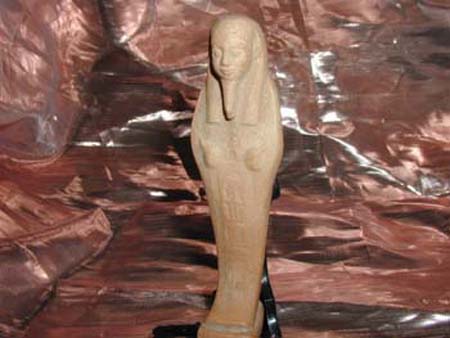
Ushabti Egyptian, Sandstone, 18th Dynasty (1570 - 1293 B.C) This example wears
a lappet wig, the Osirian Beard, has a back pillar, and carries two hoes.
Early in Egypt's history, small statues began to be placed in tombs with the
deceased. These little representations of the human mummy were inscribed with
magical spells that would provide spiritual life to these figures in the afterworld.
At first, the statues were inscribed with only the name of the deceased, but
soon they were inscribed with magical spells as well to assure that they would
really come alive to do their chores. A typical spell would be: "O shawabti,
if the deceased is called upon to do work in the next world, answer "Here
I am!" Plough the fields, fill the canals with water and carry the sand
of the east to the west." The word "shawabti" apparently referred
to the persea-tree out of which these figures were occasionally made. Another
name for them was "ushabti" which meant "answerer". The
idea was that when the deceased was called to work, the figure would answer
for him. The statues are called by both names today. Since ushabtis were provided
to do the work, it became desirable to have many of them. During the New Kingdom
it was common to have hundreds placed in the more elaborate tombs. Because
the number of ushabtis found in tombs is often nearly 365, it is believed
by many that the Egyptians intended that there be one for each day of the
year. There is no actual evidence for this, and in fact the number found is
rarely exactly 365.